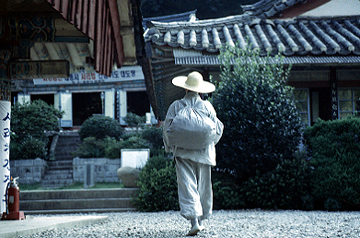
| A monk at Yonghwasa temple on Miruk Island in South Kyongnam Province. |
|
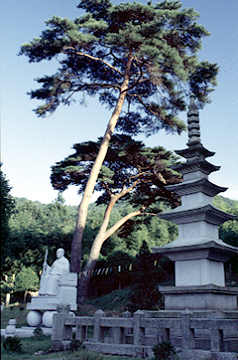 |
..the five-tier sari pagoda for Yonghwasa temple's former abbot, Hyogong, who died in the 1980's. |
| This is a stone guardian totem known as a 'poksu', or 'sokjangsung'. It was made in 1906 to ward off evil spirits and disease from the village it protects near Chungmu, in South Kyongsan. In Korea, totems like this are generally made of wood, but in the area of Chungmu and Miruk Island they are made of stone. | 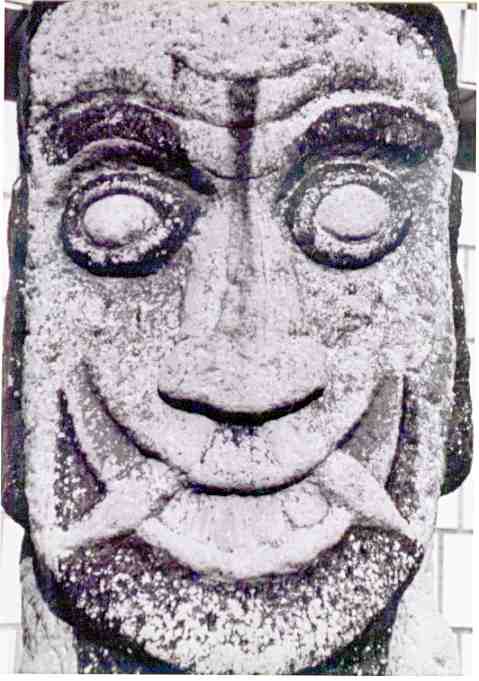
|
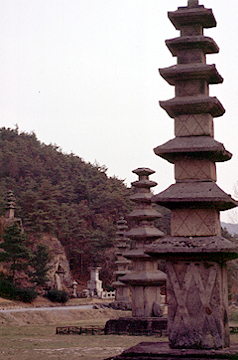 |
This is Unju-sa, a unique temple in South Cholla Province. Unju-sa has many unusual pagodas and Buddha figures. At one time, the temple was said to have thousands of these stone sculptures. According to 'Pungsu' (otherwise known as 'geomancy', or 'Feng Shui'), the Korean peninsula is unbalanced by the powerful 'Ki' (energy) of the mountains along the East Coast. These stone sculptures made in the southwestern part of the peninsula were an attempt to counterbalance the 'Ki' in the east. |
| The face of a temple guardian statue. Made of wood or clay, one can find these statues at most entrances to Buddhist temples in Korea. | 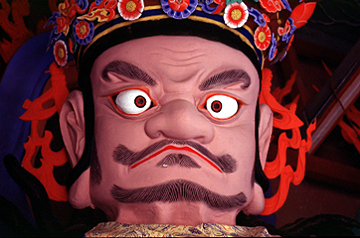
|
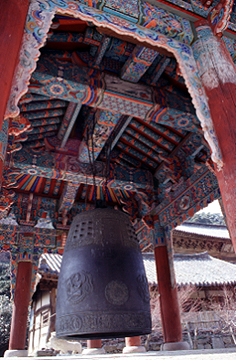 |
The iron temple bell of Hwaomsa temple in the Chiri mountains of South Cholla Province. Most temples in Korea have these iron bells hanging in similar structures as this. |
| Sunrise at the top of Mt. Wolchulsan in South Cholla.. | 
|
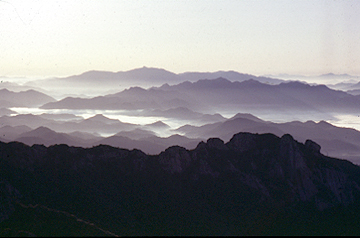 |
..seeing the sun rise on the top of Wolchulsan is truly inspiring.. |
| ..later, after the clouds had dissapated. | 
|
| Here you can see the massive rock-carved image of the Maitreya Buddha on the north slope of Kujong-bong in Wolchulsan. Carved by Paekche artists during the Silla era, it is designated National Treasure #144. | 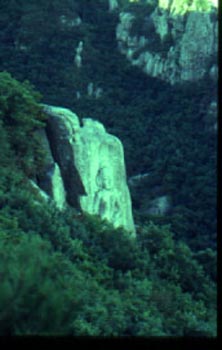
|
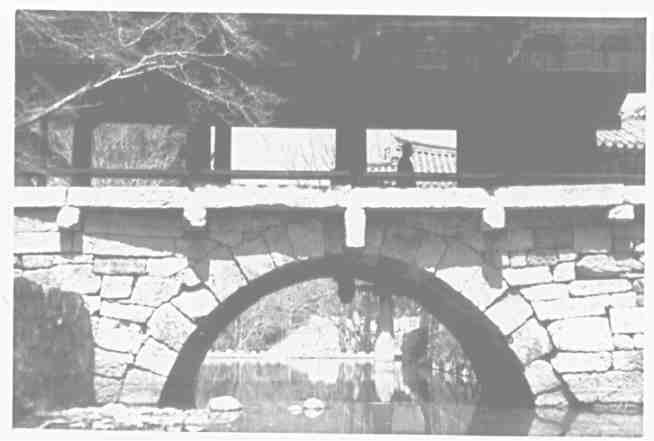 |
Near Sunchon in South Cholla, is Songgwangsa ("Spacious Pine Temple"). This temple complex was reorganized in 1969 as a monastic center for all sects of Mahayana Buddhism, and is one of the largest temple complexes in Korea. Shown here is the covered arch bridge leading to the temple's entrance. |
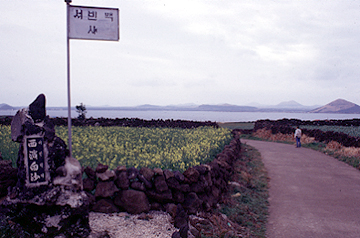 |
This is Udo, an smaller island just to the northeast of Cheju Island. Udo has an extensive round-pebble coral beach, and lots of black volcanic rock used to make walls to separate fields. |
| ..an old woman collecting seaweed on the rocks near Hyopjae Beach on Cheju Island. Cheju Island is the largest island in Korea, and is an island province unto itself. The people of Cheju Island are hearty folk, and are kind to visitors. However, these people, like the people of South Cholla Province, have suffered greatly in recent history for their past strong feelings for separation from the administrative control of the mainland. The people of Cheju fought a guerrilla war against mainland control starting in 1948, for which they paid dearly. Between 15,000 and 30,000 islanders were killed in the fighting and by terrorism committed by right-wing mainlanders. The violence ended by 1950, leaving one in every five or six islanders dead and more than half of the villages destroyed. | 
|
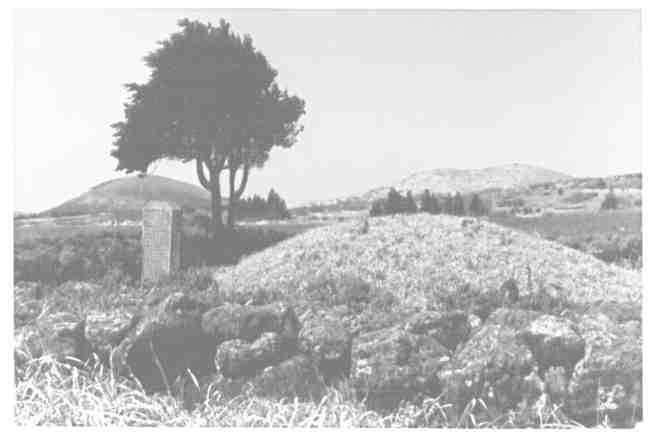 |
..a grave mound on Cheju. The mound on island graves are similar to mainland graves, however, the islanders ring them with the ever-present black volcanic rock that is found all over Cheju. |
| ..a woman sitting on the stoop of a traditional Cheju Island house. | 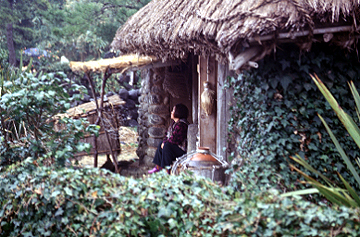
|