|
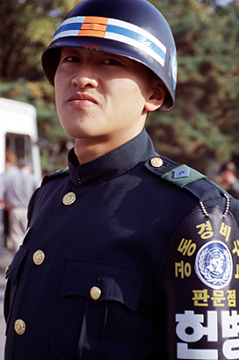
A southern soldier working in the JSA. All men in the South are expected to do some sort of military service before they are 30 years old. The length of a conscript's sevice can be anywhere from 18 months to 3 years. |
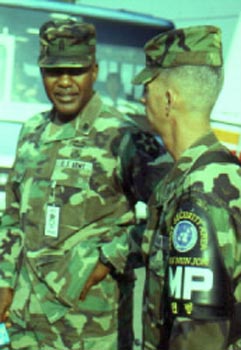 |
Noncommisioned officers of the US Army at Panmunjom. |
| North Korean soldiers working in the JSA. Actually, they are checking out the women in a tour group in the MAC building(!) People in the tour groups sponsored by the South are told not to make any gestures or talk to these soldiers. | 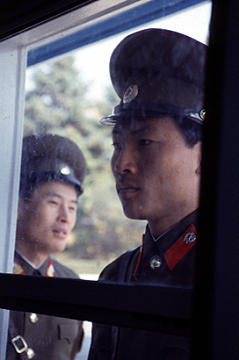
|
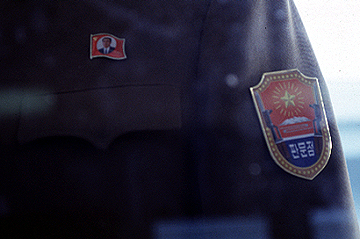 |
..the northerners wear Kim Il Sung badges on their uniforms. The sleeve emblem says 'Panmunjom', the name of a village where the JSA is situated. The village no longer exists, since it was destroyed during the war. However, the JSA is still commonly referred to as 'Panmunjom'. |
| ..looking into North Korea. The rusting yellow sign is one of many that marks the location of the border, reading: Military Demarcation Line. The signs are two-sided. Facing the North, the sign is written in Korean and Chinese; Facing the South, it's written in Korean and English. Contrast these images with the East German border in 1988. | 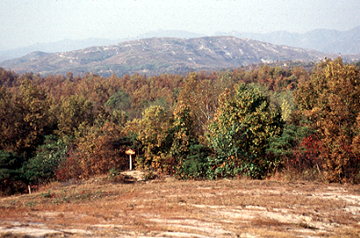
|
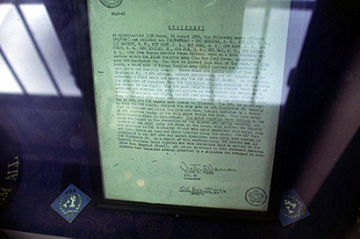 |
This is a letter of commendation from the U.S. military commander in Korea in 1976, posthumously promoting two U.S. Army officers who were killed by North Korean soldiers while trimming a tree in the JSA. The U.N. badges that the officers wore while on duty can also be seen. The cabinet that these things are in is made out of the wood of the tree that they went to trim. (The tree was cut down a short time later in an operation that was a major show of force by the United States. |
| Obliterate the American bastards..reads one line in this primary-school reader from North Korea. The North considers the U.S. as their number one enemy, and Japan, a very close number two. | 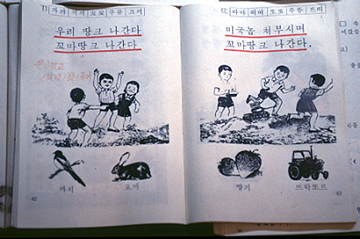
|
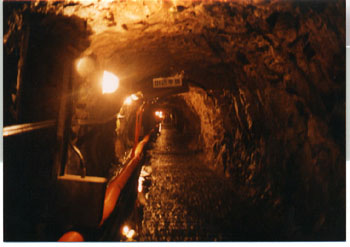 |
The Third Infiltration Tunnel at Panmunjom. Dug by the North Koreans on their side of the MDL, it was discovered south of the MDL by ROKA troops in 1978. Lying 73 meters below ground, it is about 2 meters wide and would have been supposedly large enough to channel a whole division of Northern troops per hour into the south had it been completed and used. |
| ..this is where the interceptor tunnel the South Koreans built meets the infiltration tunnel. Straight ahead down the tunnel, just below the MDL, the tunnel has been sealed off and a guardpost stationed. | 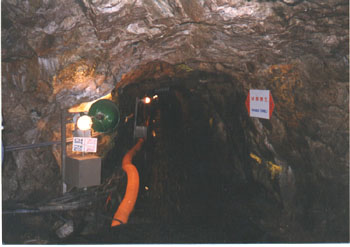
|
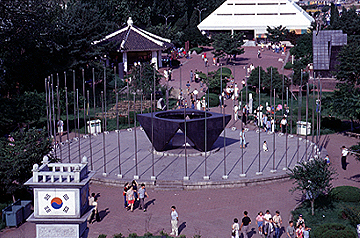 |
This is the memorial to the U.S. commitment to the war in Korea, just south of 'Freedom Bridge'. The four triangular panels represent the four services of the U.S. armed forces that took part in the war. There are 50 flag poles representing the states of the U.S where the servicemen came from.. |
| ..at the base of each flagpole is the state seal of that state. This one is Minnesota. | 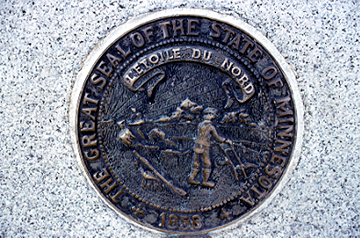
|
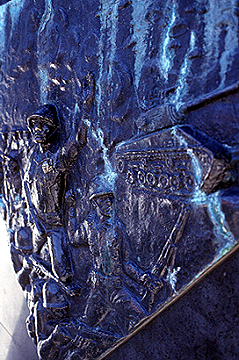 |
..a detail of the panel depicting the Army. |
| This is the Shrine of the Unknown Soldiers at the National Cemetary (near Tongjak station). Inside, are listed the names of Korean MIAs from the Korean War. It's like a grave in there-very cold, dark, but also extremely clean, and it smells like a buddist temple with incense burning all the time. | 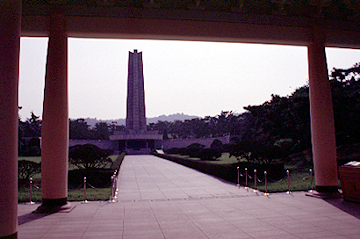
|
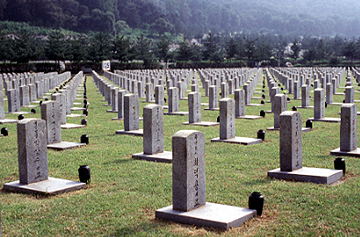 |
..over 4,000 soldiers are buried here, most from the Korean War. Others are Vietnam casualties, high ranking officers, and policemen. One section is set aside for those who fought for independence from the Japanese. |
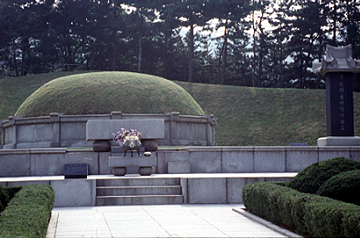 |
..This is the grave of Yi Seung-man (Syngman Rhee). He was the first president of the Republic of Korea. A controversial figure, Rhee was the U.S. Military Government's choice for leader of the South in the late 40's, and only because he was one of the few anti-communist Korean political leaders around. He ruled as an autocrat. He justified his style of rule as necessary in the face of the North Korean threat, setting a precedent for all other Korean presidents to follow. He was extremely unpopular in Korea by the time he resigned as a result of the April, 1960 Student Revolution. He died in exile in Hawaii in 1965. |
| There are dozens of Korean War-era memorials one can see around the country. This is the Inchon Landing memorial in Inchon. It commemorates the amphibious landing by U.S. and Korean Marines on September 15th, 1950. Some say the 'surprise' landing caught the North Korean Army (Inmingun) off guard, but actually they knew the attack had been coming for at least a week before it took place. By the time the landings took place, less than 3 months after hostilities began, the U.S. alone had already suffered 20,000 casualties, with 4,280 dead. The Bad Old Days | 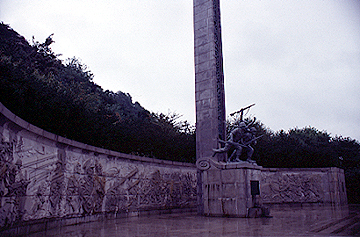
|
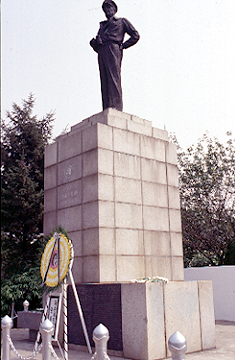 |
..A statue of Douglas MacArthur stands looking out over modern Inchon Harbor. MacArthur was a dangerous warmonger who wanted to drop atomic bombs on China, and that was one reason why Truman fired him (in addition to criticizing the president's leadership!) |
| This is a memorial north of Seoul for the First Battalion of the Gloucestershire Regiment of the British Army that made a heroic holding action on a hilltop in April of 1951. After the battle, 169 out of 850 Gloucesters were left, the majority of the others were captured, wounded, or dead. | 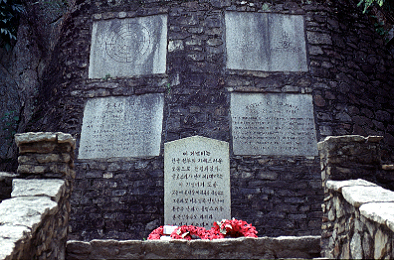
|
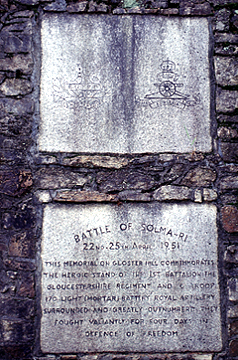 |
..a detail of the monument. |
| A statue of a memorial at the foot of the Chiri Mountains in southern Korea. It's dedicated to the Korean Army and National Police forces that suppressed South Korean communist partisans in the late 40's. Again in the 50's, North Korean soldiers fled into the Chiri mountains and held on until a year after the Korean War was over. | 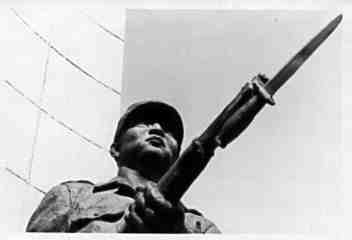
|