Undated Memo Concerning Dokdo: "Answers to Questions Submitted by the Australian Government Arising out of Statement of Principles Regarding a Japanese Treaty Prepared
by the U.S. Government" -written by Robert A. Feary of the Office of Northeast Asian Affairs, U.S. State Department (probably from October of 1950)
This page from Foreign Relations of the United States is a copy of a memo sent to the Australian government during the early stages of the drafting of the San
Francisco Peace Treaty (which formally ended the Pacific War between the Allied Powers and Japan). The American ideas put forth in this "Statement of Principles"
eminated from elements in the U.S. State Department that were heavily influenced by Japanese Foreign Ministry opinions regarding territorial concerns in Northeast Asia.
Having lobbied American Occupation and State Department officials extensively on the issue, and having painstakingly prepared and widely distributed their monograph, Minor
Islands in the Sea of Japan (1947), the Japanese Foreign Ministry´s opinion regarding the sovereignty of Dokdo (Liancourt Rocks) gets credit with the Americans at this
early stage. The Korean view, which the government of Syngman Rhee (Yi Seung-man) expressed peripherally and haphazardly at best, did not have the same influence with
people like Robert A. Feary, the drafter of this memo. As the Americans saw an opportunity with the peace treaty to get Japan on the U.S. side in the emerging Cold War,
the Americans were clearly trying to implement provisions in the treaty which would please Japan. However, neither the Americans nor the Japanese had envisioned that the
Koreans would put up the opposition that they eventually did to the plan to place Dokdo under Japan´s control. Indeed, in their negotiations with the British
Commonwealth (who wanted a definitive territorial line drawn around Japan that excluded Dokdo from Japan), the Americans did toy with the idea of placing Dokdo within
Korea´s territorial waters. In the end, Dokdo was deliberately left out of the treaty, and therefore the opinion expressed in this memo regarding Dokdo (cited as "Takeshima") never
materialized in the wording of the treaty.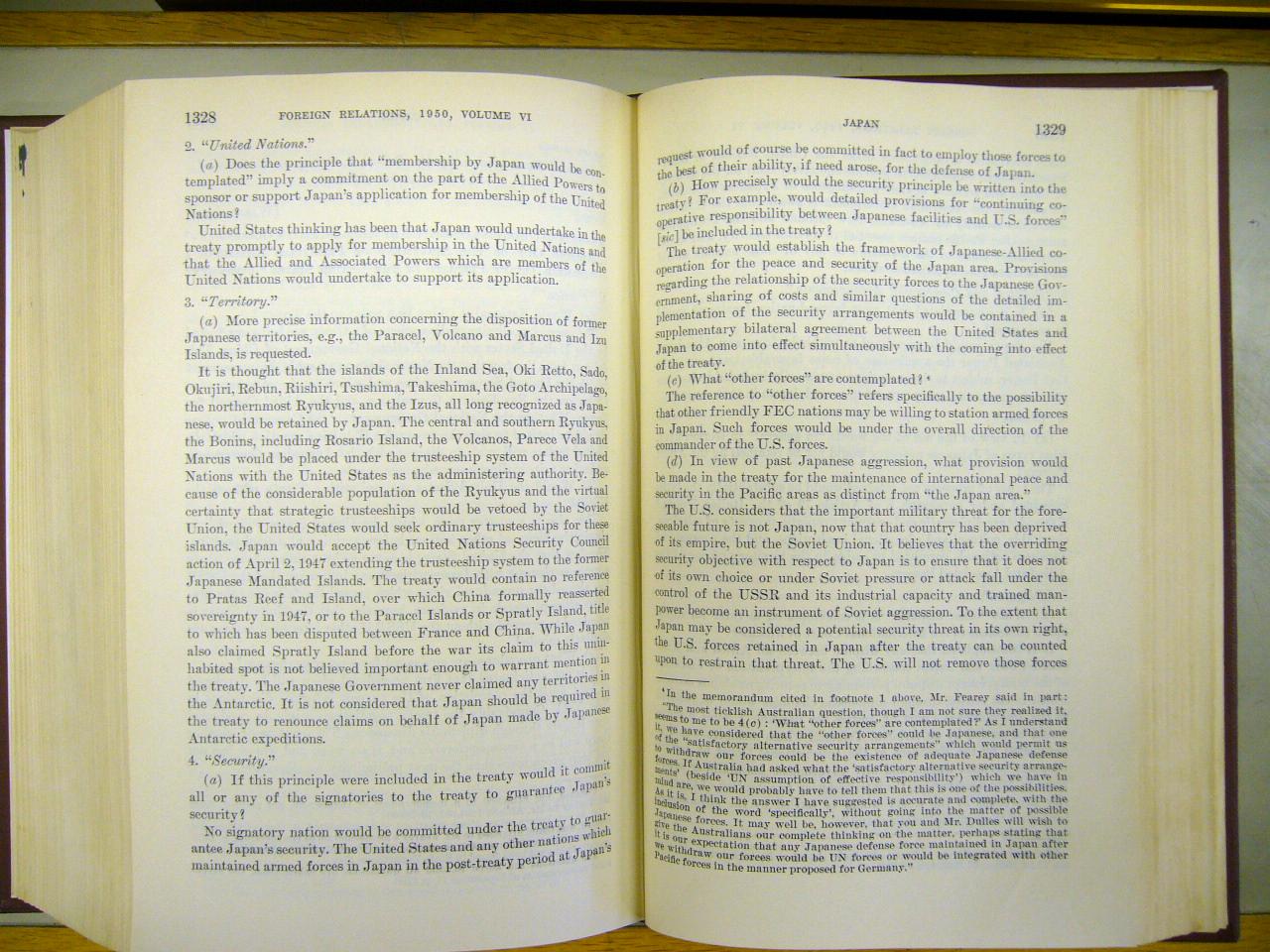
HOME