|
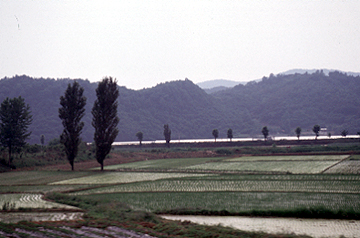
When travelling around in Korea, you can't help but notice the presence of agriculture everywhere. Here are flooded rice paddies, soon after planting. |
| ..by mid summer, the fields start to get greener.. | 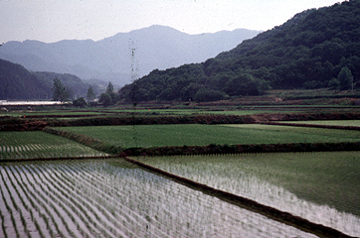
|
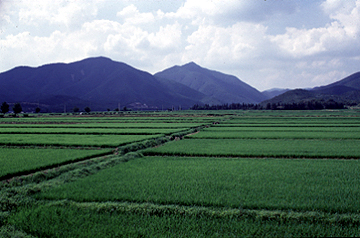 |
..in late summer the fields are dark green in color, and the rice has grown tall. |
| ..a row of growing rice seedlings. About 1/4 of all land in the Republic of Korea is under cultivation, with 55% of it being wet rice paddy fields. Rice production amounts to 80% of the principal grain harvest. The average household farm owns about 1.3 hectares of land. | 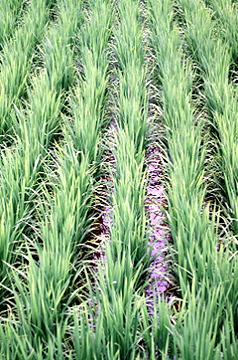
|
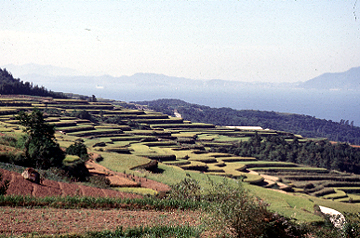 |
..some terracing is done on low-gradient hillsides, but recently, with the broad redistribution and redesigning of lands, most fields are generally flat, squared off sections (like the ones above). |
| ..farmers working the land in South Cholla. | 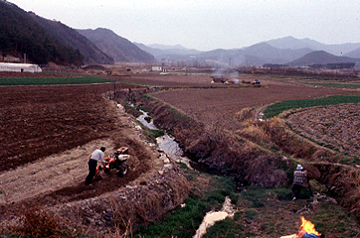
|
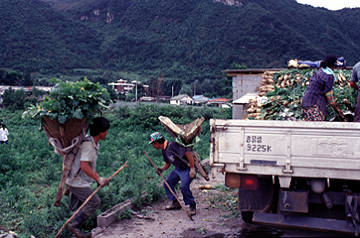 |
..here workers load a truck full with radishes in Kangwon Province. |
| These farmers are probably spraying their rice paddy with a pesticide. | 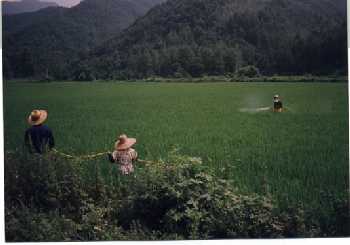
|
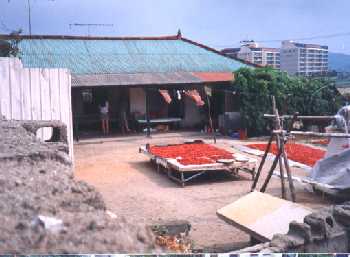 |
Here a farm family in Kangchon dries red peppers in their yard. |
| This is a farming residential neighborhood in Kangchon. | 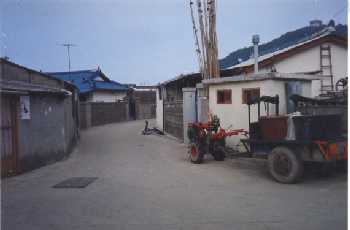
|
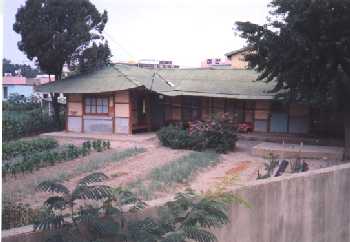 |
...a countryside home. |
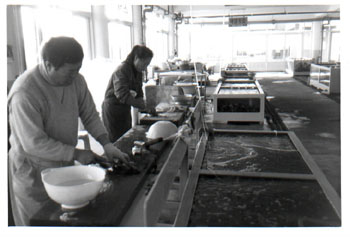 |
Here, some chefs prepare raw fish at a seafood restaurant. |
| A memorial shrine dedicated to a virtuous woman. | 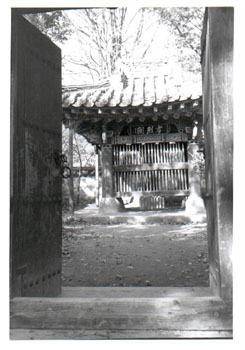
|
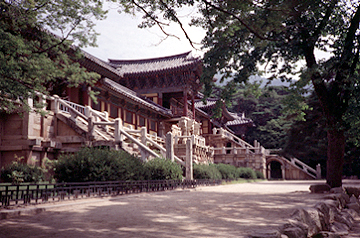 |
No trip to Korea would be complete without visiting some of the country's most famous Buddhist temples. This is Pulguksa, probably the most famous of all Buddhist temples in Korea. Founded in 751 during the Silla Dynasty, it's been ruined twice (during the Imjin War (1592-1598) and during the Korean War (1950-1953)). Here, two of the most famous pagodas in Korea stand, just inside these gates. The upward-reaching stairways seen here were meant to symbolically lift the Buddhist devotee up and out of the decadent world and into the spiritual realm. |
| ..the swastika symbol for Buddhism adorns the Musoljon (Hall of Silence), the largest hall in Pulguksa. | 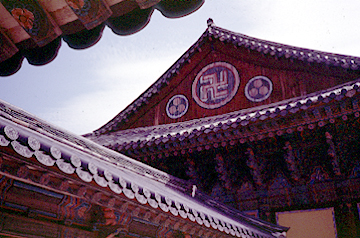
|
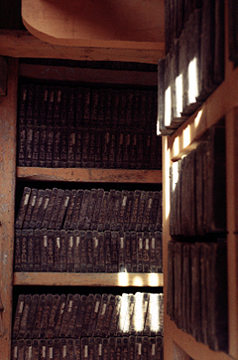 |
Haeinsa is a temple that holds the Koreana Tripitaka, the most complete, authentic, and technical version of the Mahayana Buddhist canon in the world. Tripitaka means "three baskets", denoting the three books of which it is comprised: the first, 'Kyong', are the sutras and the teachings of the historical Buddha, and the Buddha's contemporary disciples. The second, Yul, concerns the rules of living for monks, and the third, Non, contains religious commentaries by later writers. The Tripitaka is written on 81,258 wooden printing blocks, all of which are engraved on both sides, with the characters carved backwards in 23 14-character columns. The blocks are stacked in an environment-controlled library, as you see here, and lined up on wooden runners with space in between for air circulation. |
| ..the ornately decorated side of a hall in Haeinsa. Many temple buildings in Korea are brightly painted with depictions of stories from the sutras, (unlike the plain wooden temple buildings of Japan). | 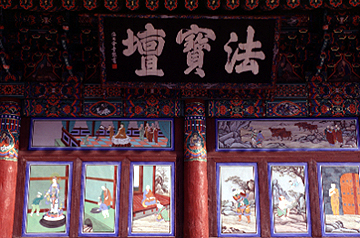
|
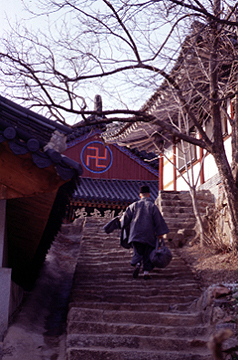 |
..a monk walking up a staircase at Haeinsa. |