|
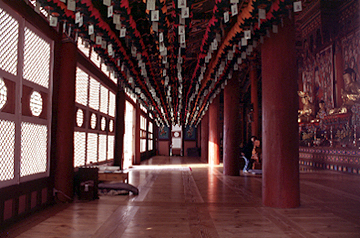
The interior view of a temple's main hall. |
| ..a Buddist praying in a temple hall. Korean Buddhists genuflect like this in front of the image of Buddha. | 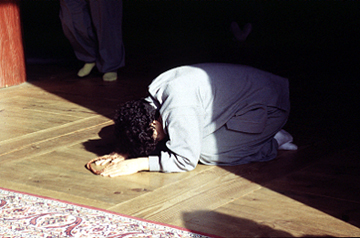
|
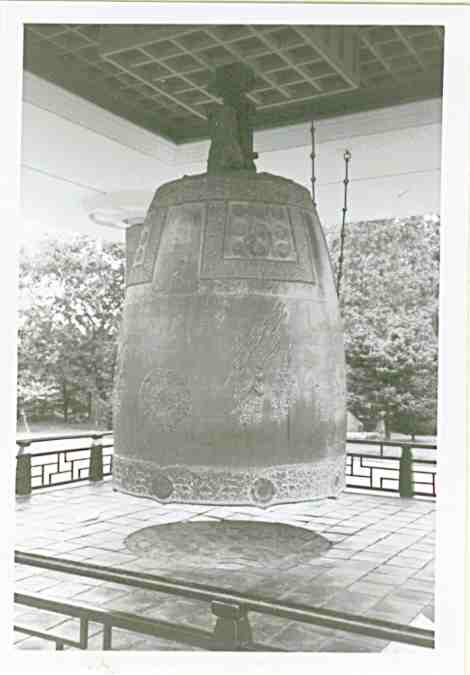 |
Here at the Kyongju National Museum hangs Korea's most famous bell. Known as the 'Emille Bell', it was cast in 771 to commemorate the Silla Dynasty's King Songdok. It's 3.5 meters high and 2.5 meters tall and weighs 23,000 kg. The name of the bell comes from the legend connected to the casting of the bell: After failed attempts to cast the bell, the temple's head monk was inspired by a spirit in a dream to find a young girl born in the year, month, day, and hour of the dragon. She was to be thrown into the molten casting metal before it was poured in order to appease the fire spirit dragon. This was done, and the bell was successfully cast. However, when they went to strike the bell for the first time, it didn't boom like a bell, but sounded with the mournful cry of the child for her mother in the ancient Silla langauge-"emille..". |
| The only remains of a Silla summer palace, this granite watercourse called Posokjong was used by the royalty to play poetry games. Cups of wine were floated down the winding course to people who were to write a poem on a particular subject before the wine reached where they were sitting. If they couln't finish the poem before the cup arrived, then they had to drink. After a few cups, the poems were probably more difficult (or more easy) to write. | 
|
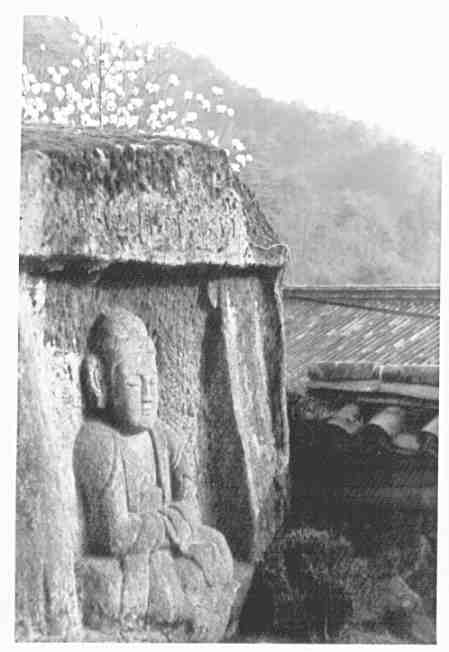 |
A Buddha figure carved into rock. |
| This is Pirojon hall of Chikjisa temple in North Kyongsan Province. On the altar are hundreds of look-alike Buddha disciple statues. This temple is quite old- 1,580 years old, last being rebuilt in 1610 after being burnt down by Hideyoshi's troops during the Imjin War (1592-1598). | 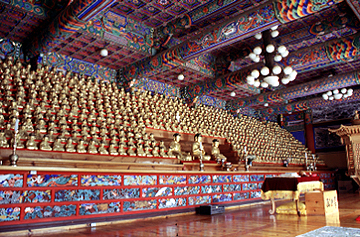
|
| Buddhists bow to the gate guard statues inside Chonwangmun at Pusoksa in North Kyongsan. | 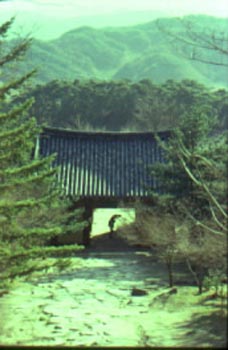
|
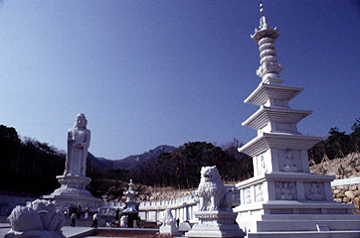 |
This is the Tongil (Unification) Buddha complex in the Palgongsan mountains near Taegu. The size of this semicircular complex is impressive. In the middle stands a huge Yaksa Yorae Buddha statue dedicated to the peaceful unification of the Korean peninsula. |
| One of the two identical 13-meter high pagodas of Kamunsaji, near Kyongju. The twin pagodas and the foundation stones are all that is left of this old Silla-era temple. Kirimsa Temple was a large and influential temple in the Silla Dynasty, and was much grander than Pulguksa at the time. | 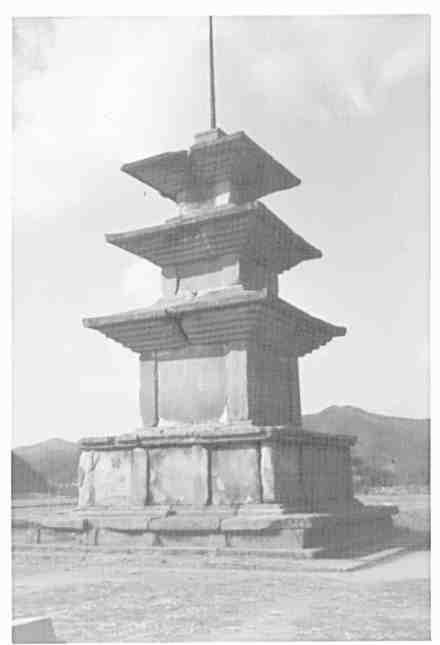
|
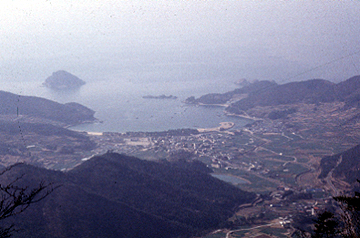 |
This is Sangju Beach, as seen from the top of Mt. Kumsan on Namhae Island In South Kyongsan Province. This is one of the finest white-sand beaches in Korea. |
| ..a hermitage near Mt. Mangwoonsan on Namhae Island. | 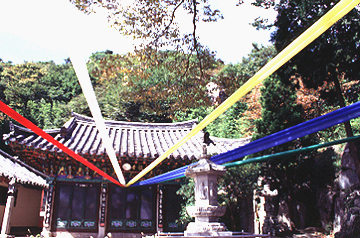
|
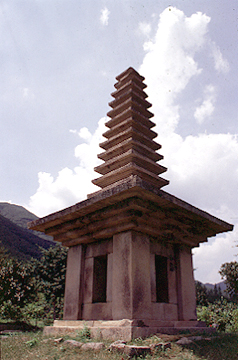 |
The 13-tier pagoda of Chonghyesa. This pagoda marks the site of a 9th Century temple of the Silla Dynasty. |